There's no federal e-bike credit, but ten states and several cities run their own. Which programs are open in 2026, how much they pay, and how to stack a state, city, and utility rebate on one bike.

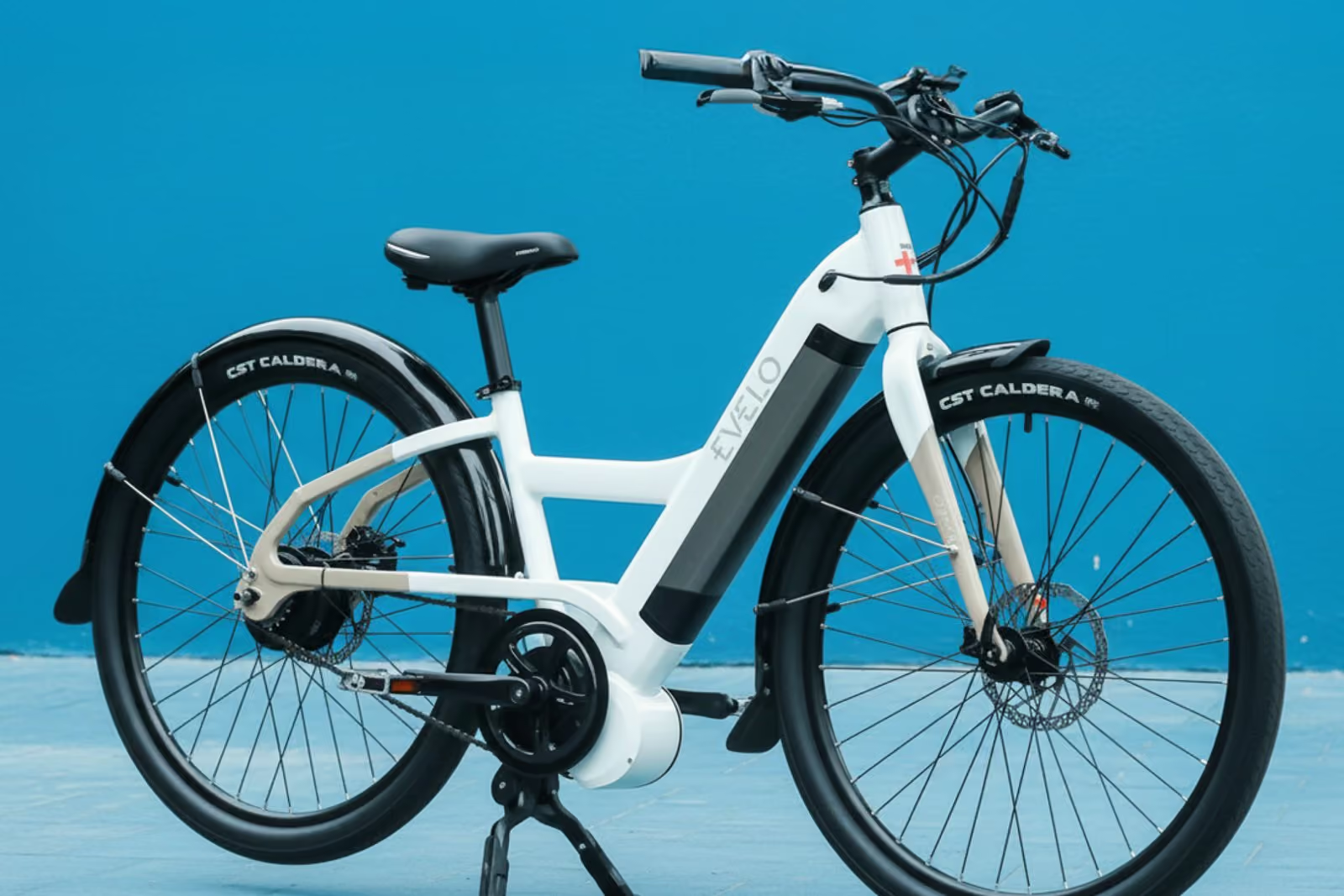
Several states and cities will help pay for your next e-bike in 2026, from an instant $225 off at the register in Colorado to a $2,000 voucher for a cargo e-bike in Washington, D.C. The catch is that many run as lotteries, are income-limited, or open only for a short window each year, and a few have closed or ended entirely. This guide shows you what is genuinely open today, how much you can get, and the one thing to do next.
We check it on a set schedule and stamp the date at the top, because this is a fast-moving area and most of what you will find elsewhere is out of date.
There is no federal e-bike tax credit. The federal E-BIKE Act has been introduced four times since 2021 and has never become law. If a retailer advertises a "federal e-bike credit," they are pointing at a bill, not a benefit. Every real incentive in this guide is run by a state, city, or electric utility.
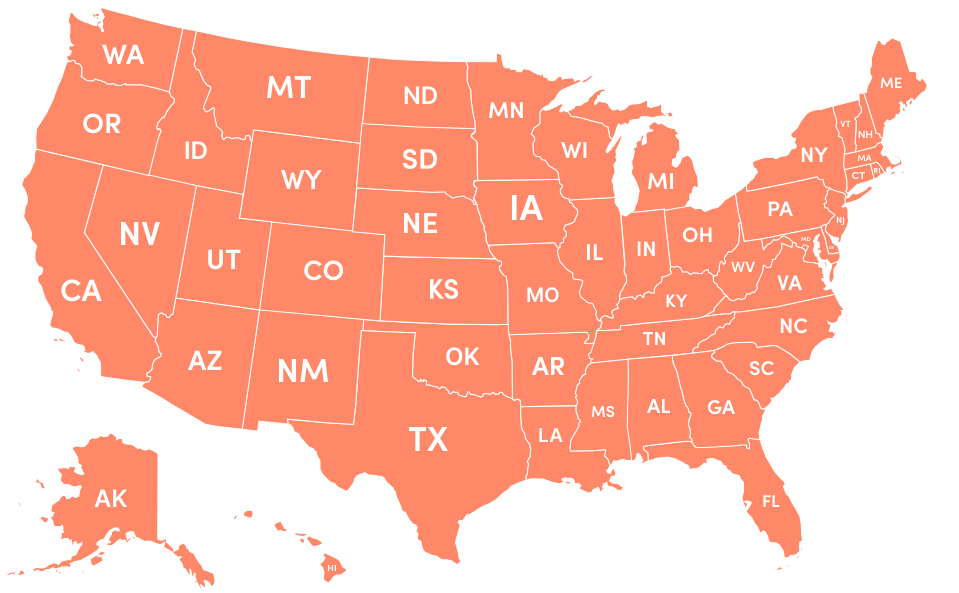
Every program at a glance, the ones you can act on first. "Income-qualified" is the higher amount you may get on a reduced income.
| State | Standard | Income-qualified | How it works | Status |
|---|---|---|---|---|
| Colorado | $225 | +$675 Denver | Instant at register | Active thru 2032 |
| New York | None | Bill pending | Not yet law | No active program |
| Massachusetts | $800 | $1,200 + $150 gear | Voucher (lottery) | Lottery |
| Rhode Island | $350 / 30% | $750 / 75% | Buy first, claim back | Active |
| Hawaii | $500 / 20% | Qualifier-based | Buy first, claim back | Active |
| Connecticut | $500 | $1,250 | Voucher | Check current round |
| Washington, D.C. | $1,500 | $2,000 cargo | Voucher | Active |
| Tampa, FL | Up to $3,000 | Lottery | Voucher (city) | 2026 round closed |
| California | $1,750 | $2,000 priority | Voucher | Statewide ended |
| Minnesota | Ended | - | No 2026 round | Ended |
| Washington | $300 | $1,200 | Buy first, claim back | Open now |
The biggest wins come from layering. Your state, your city, and your electric utility each run their own program, and in a few places they combine on a single purchase. Denver is the clearest example: the $225 state credit plus Denver's income-qualified city rebate can take around $900 off one bike, and more for an adaptive e-bike.
[IMAGE: savings-stack diagram - state $225 + Denver income-qualified city rebate up to $675 = about $900 standard, more for adaptive]
The lesson is simple. Before you buy, check all three levels, not just your state.
Every program is one of three shapes, and the difference decides whether you save at the till or wait months for money back.
Instant at the register. The discount comes off the price when you buy, at a participating shop, with nothing to claim later. Colorado works this way.
Voucher first, then buy. You apply online, and if you are approved, often by lottery, you get a code to redeem in store. Connecticut and Massachusetts run like this.
Buy first, claim back. You pay full price, then apply for money back afterwards. Rhode Island and Hawaii use this. Keep your receipt.
One thing shows up almost everywhere: UL 2849 certification. It is the safety standard for an e-bike's battery and electrical system, and nearly every program now requires it. More on why that matters for your wallet later.
Colorado runs the most reliable incentive in the country, and the only one with no income cap. The credit dropped to $225 for 2026, down from $450 after a state revenue adjustment, but it still comes off instantly at the register and is funded through 2032.
You get
$225 off instantly for any Colorado resident. Denver residents can add a city rebate on top, up to $675 for income-qualified households and more for adaptive e-bikes.
Who qualifies
Colorado resident, one credit per person per calendar year, with proof of residency at purchase.
The bike
A new Class 1, 2, or 3 e-bike with UL 2849, UL 2271, or EN 15194 certification.
What to do
Buy at a participating retailer and complete the DR-0514 affidavit in store, with no pre-application. Full rules are on the Colorado Department of Revenue page.
Despite what many roundups claim, New York has no active statewide e-bike rebate in 2026. The Ride Clean Act, which would create one, has passed the State Senate several times but keeps stalling in the Assembly, and it is still only a pending bill (S1047).
You get
Nothing statewide yet. If the Ride Clean Act passes, it proposes 50% of the price, up to $1,100.
Who qualifies
To be set by the bill if it is enacted. Income limits are expected.
The bike
To be defined by the program if it launches.
What to do
Check your city or electric utility for a local program, and follow the bill on the New York Ride Clean site. Do not count on a statewide rebate until it is signed into law.
Launched in April 2025 through the Massachusetts Clean Energy Center, this one stands out for adding up to $150 toward safety gear on top of the bike rebate. It runs as a lottery with income-based tiers.
You get
$800 standard, or $1,200 if income-qualified, plus up to $150 toward helmets, lights, and locks for every winner.
Who qualifies
Massachusetts resident aged 18 or over, with an enhanced tier for lower incomes and a standard tier with higher limits.
The bike
A new pedal-assist e-bike from a participating retailer, UL 2849 expected.
What to do
Apply through the online portal. Winners are drawn by lottery and have 60 days to redeem.
Named for cycling advocate Erika Niedowski, Rhode Island's rebate is refreshingly simple, and its income-qualified tier is one of the most generous percentage rebates anywhere.
You get
$350 or 30% of the price as standard, rising to $750 or 75% if income-qualified.
Who qualifies
Rhode Island resident, with the higher tier for lower-income households.
The bike
A new e-bike under standard class rules.
What to do
Apply online after you buy, with proof of residency and your receipt, and check the Rhode Island Office of Energy Resources for current funding.
Hawaii takes a different route to eligibility. Rather than an income threshold, you qualify by being in a government assistance program, being a student, or being car-free.
You get
Up to $500 or 20% of the retail price.
Who qualifies
Hawaii resident who meets at least one of the routes above.
The bike
Eligible e-bikes and electric mopeds under standard class and wattage rules.
What to do
Apply online after purchase with proof of your eligibility, through the Hawaii Department of Transportation. Funding is limited and first-come.
Connecticut's rebate is run by the state's Department of Energy and Environmental Protection through the Center for Sustainable Energy, and it works as a voucher redeemed at a participating in-state retailer.
You get
$500 as a standard voucher, rising to $1,250 with the enhanced Voucher+ tier.
Who qualifies
Connecticut resident. The enhanced tier is for those on a qualifying income program, under 300% of the Federal Poverty Level, or living in an environmental-justice or distressed community.
The bike
A new e-bike from a participating Connecticut retailer.
What to do
It runs in rounds that open when funding allows, so check the Connecticut DEEP program for the current round before you buy.
Vermont layers a state incentive with separate rebates from local electric utilities. The state program's 2026 funding is not confirmed, but the utility rebates can be worth real money on their own.
You get
Up to $400 from the state (up to $800 for cargo or adaptive), plus roughly $100 to $600 from local utilities, and up to $850 from Burlington Electric for income-qualified customers.
Who qualifies
Vermont resident. Utility rebates vary by provider (Green Mountain Power, Burlington Electric, Stowe Electric, VPPSA).
The bike
A new e-bike under standard safety rules, Class 1 for some utility programs.
What to do
Check your electric utility directly first, since those often run even when the state program is paused.
California's statewide voucher was among the most generous at up to $2,000, but the CARB E-Bike Incentive Project wound down at the end of 2025 with no further rounds planned, so statewide help is effectively over.
You get
Up to $1,750 standard, or up to $2,000 for priority applicants, when the program last ran.
Who qualifies
California resident aged 18 or over. Priority went to households at or below 300% of the Federal Poverty Level and residents of disadvantaged communities.
The bike
A Class 1, 2, or 3 e-bike with UL 2849, bought at a participating retailer.
What to do
Check your county or city program now. The statewide CARB voucher has ended, so do not wait on it.
Minnesota ran one of the most generous rebates in the country, but it was a one-time, 2023-funded program that has now ended. It closed at the end of 2025 with no 2026 round.
You get
Nothing in 2026. When it last ran in 2025 the maximum had already dropped to $750, down from $1,500 the year before.
Who qualifies
Not applicable for 2026.
The bike
Not applicable for 2026.
What to do
Check your city or electric utility for a local program, and watch the Minnesota Department of Revenue for any new state funding.
Washington's WE-Bike program was a hit in 2025, offering 6,861 rebates from nearly 38,000 applicants and helping about 3,000 people buy. The good news for 2026 is that the legislature renewed it with $7 million for 2025 to 2027, and the latest round has been open since March.
You get
$300 standard, or $1,200 if income-qualified at or below 80% of your county's median income.
Who qualifies
Washington resident, with the higher amount for income-qualified households.
The bike
An e-bike meeting state class rules, UL 2849 required.
What to do
Apply through the WE-Bike program while the current round is open. It uses a mix of first-come and lottery, so do not wait.
Some of the best deals are local, especially where there is no statewide program.
With no state above it, D.C. runs its own program with some of the highest amounts in the country. Lower-income residents can get up to $1,500, or $2,000 for a cargo e-bike, while everyone else gets up to $750, or $1,000 for cargo. It is income-tiered for D.C. residents, and rounds open periodically through the online portal. The D.C. incentive program law sets out the detail.
Florida has no statewide program, but Tampa runs a city voucher that returns most years, with a 2026 cap of $3,000 tiered by income, the highest single-city amount in the country. The 2026 application window ran in February and has closed, so the thing to do now is watch for the next round. It is lottery-based for Tampa residents and redeemed at a participating local shop. The City of Tampa posts each round.
Texas has no statewide program, but Austin Energy offers a utility rebate to its customers of up to $600 as standard, or up to $1,300 for income-qualified customers on its Customer Assistance Program. Apply through Austin Energy.
Not listed here? Some states have no program of their own, but your city or electric utility might. Municipal electric companies in particular often run rebates that never make the "state programs" lists. It is always worth a five-minute check with your local utility before you buy.
You will see the "E-BIKE Act" mentioned a lot. It would create a 30% refundable federal tax credit capped at $1,500 for e-bikes under $8,000. It has been introduced repeatedly since 2021 and reintroduced in 2023 and 2024, and it has never passed Congress. As things stand in 2026, there is no federal e-bike tax credit. Do not count on one, and be wary of any seller who implies otherwise.
Here is something worth knowing. The same UL 2849 battery certification that qualifies your e-bike for nearly every rebate above is a safety standard, not a theft or crash one. A rebate gets you a safer, cheaper bike. It does nothing if that bike is stolen off your porch or written off in a crash.
And your home insurance probably will not fill the gap. Most homeowners and renters policies cap bikes well below what an e-bike costs, and many exclude anything with a motor. That is the whole reason specialist cover exists. (More on that in our guide to whether homeowners and renters insurance covers your e-bike.)
Sundays covers theft, accidental damage, and more from about $8 a month, built by cyclists for cyclists. If you are about to spend real money on an e-bike, it is worth two minutes to see what covering it costs.
Is there a federal e-bike tax credit in 2026?
No. The federal E-BIKE Act has been introduced several times but has never passed Congress. In 2026 there is still no federal e-bike credit. Every incentive that actually exists is run by a state, city, or electric utility.
Can I combine more than one rebate?
Often, yes. State, city, and utility programs are usually separate, and in places like Denver they stack on a single purchase. Read each program's rules, since a few exclude combining with others.
What is UL 2849 and why does it keep coming up?
It is the safety standard for an e-bike's battery and electrical system, designed to prevent fires. Nearly every rebate now requires it, and it is a good thing to look for even where no rebate applies.
My state's program is closed. What can I do?
Check whether your city or electric utility runs one, since those often continue when a state program pauses. It is also worth watching for the next application window, as many programs reopen with new annual funding.
Do rebates cover used e-bikes?
Almost never. Nearly every program requires a new e-bike bought from a participating or licensed retailer.
Incentive amounts, funding, and application windows change often. Always confirm current status on the official state, city, or utility website before you purchase. Sundays is not affiliated with any of these programs. Figures in this guide were verified July 2026.
Each program links to its official source in its own section above. Two general references: the federal E-BIKE Act (H.R.1685) on Congress.gov, and the UL 2849 safety standard from UL Solutions. All details verified July 2026.




.avif)

.avif)

